
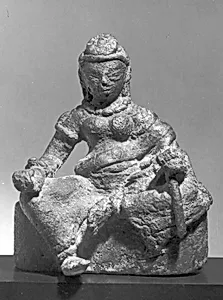
Seated Goddess
Unknown Artist
2nd–3rd century
Medium
Bronze
Dimensions
H. 3 1/4 in. (8.3 cm)
Classification
Sculpture
Culture
India
Department
Asian Art
Museum
Metropolitan Museum of Art, New York, NY
Credit
Samuel Eilenberg Collection, Gift of Samuel Eilenberg, 1987
Accession Number
1987.142.338
Rights
Public Domain
Tags
Art Historical Context
This delicate bronze sculpture, *Seated Goddess*, hails from India's Kushan period (2nd–3rd century), crafted in the renowned Mathura school hub of artistic innovation under the multicultural Kushan Empire. Standing just 3¼ inches (8.3 cm) tall, the unknown artist depicts a serene female deity in a seated pose, embodying the era's fusion of indigenous Indian traditions with Hellenistic and Central Asian influences. Mathura's sculptors excelled in rendering divine figures with graceful proportions and intricate details, often for temples or personal devotion. Bronze, a precious medium rarer than Mathura's signature red sandstone, highlights advanced lost-wax casting techniques that allowed for fine jewelry-like embellishments and smooth surfaces. This small scale suggests it served as a votive object, carried by pilgrims or enshrined in homes to invoke the goddess's blessings—reflecting the Kushan era's vibrant worship of female divinities like Lakshmi or Durga precursors, central to emerging Hinduism. Today, this treasure from the Samuel Eilenberg Collection graces the Metropolitan Museum of Art's Asian Art department, offering a window into ancient India's spiritual artistry and the Kushans' role in bridging cultures along the Silk Road.