
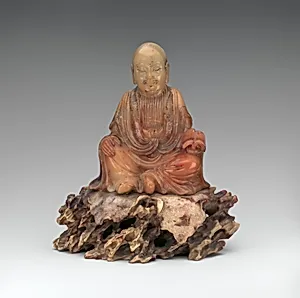
清 壽山石雕靜坐羅漢|Seated luohan holding a book
Unknown Artist
18th century
Medium
Soapstone
Dimensions
H. 7 1/16 in. (18 cm)
Classification
Stone
Culture & Period
China · Qing dynasty (1644–1911)
Department
Asian Art
Museum
Metropolitan Museum of Art, New York, NY
Credit
Gift of Florence and Herbert Irving, 2015
Accession Number
2015.500.5.26
Rights
Public Domain
Tags
Art Historical Context
Nestled in the Metropolitan Museum of Art's Asian Art collection, this exquisite18th-century Qing dynasty soapstone carving depicts a serene seated luohan or arhat, holding a book. Carved from prized Shoushan stone—a yet durable soapstone sourced from Fujian province—the figure stands just 7 1/16 inches tall, the medium's ideal qualities for intricate sculpting. Its smooth, waxy surface and subtle color variations lend a lifelike warmth to the monk's contemplative pose, robes flowing naturally, and the open book symbolizing wisdom and enlightenment. Luohans hold profound significance in Chinese Buddhism as the Buddha's enlightened disciples, revered as protectors of the faith and exemplars of spiritual attainment. During the Qing era (1644–1911), such carvings flourished among scholar-officials and collectors, blending devotional piety with aesthetic appreciation. This unknown artist's masterful technique captures the luohan's introspective gaze and textured drapery, highlighting soapstone's versatility for fine details unattainable in harder stones. A generous gift from Florence and Herbert Irving in 2015, this piece invites visitors to ponder the enduring fusion of artistry and spirituality in imperial China, where everyday meditation met monumental devotion.