
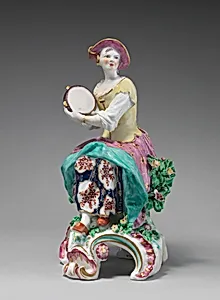
Seated musician (one of a pair)
ca. 1765
Medium
Soft-paste porcelain
Dimensions
8 7/8 × 5 in. (22.5 × 12.7 cm)
Classification
Ceramics-Porcelain
Culture
British, Bow, London
Department
European Sculpture and Decorative Arts
Museum
Metropolitan Museum of Art, New York, NY
Credit
Gift of Irwin Untermyer, 1964
Accession Number
64.101.702
Rights
Public Domain
Tags
Art Historical Context
This charming *Seated Musician ( of a pair)*, by the Bow Porcelain in London around 1765, exemplifies early British porcelain artistry. Established in the 1740s, Bow was among England's pioneering factories, crafting soft-paste porcelain—a translucent, bone-china-like material fired at lower temperatures than true hard-p from China. This innovation allowed for, mass-produced luxury goods, hand-modeled and vividly enameled to mimic costlier imports, making elegant decor accessible to the growing middle class during the Georgian era. Depicting a poised female musician—likely with a lute, flute, or similar instrument, as suggested by its tags—the figurine embodies the Rococo taste for whimsical, theatrical scenes. One of a harmonious pair, it reflects 18th-century fascination with domestic music-making, where women often performed in salons and homes. The factory's skilled artisans excelled in dynamic poses and colorful glazes, capturing movement and personality in miniature form (8⅞ × 5 in.). A gift to the Metropolitan Museum of Art from Irwin Untermyer in 1964, this piece highlights Bow's cultural role in democratizing fine arts, blending technical ingenuity with the era's love for melody and merriment.
About the Artist
Bow Porcelain Factory · 1747–1776
The Bow Porcelain Factory, established around 1747 in East London near Bow and relocated by 1749 to "New Canton" east of the River Lea, emerged as one of England's pioneering soft-paste porcelain manufacturers, rivaling the Chelsea factory. Founded by merchant Edward Heylyn and Irish painter Thomas Frye, who secured key patents in 1744 and 1748–49 for using Cherokee kaolin and bone ash, the factor...