
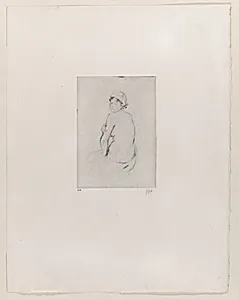
Seated Nude Seen from Behind
1889
Medium
Drypoint on wove paper
Dimensions
sheet: 14 x 10 15/16 in. (35.5 x 27.8 cm) plate: 5 7/16 x 4 5/16 in. (13.8 x 10.9 cm)
Classification
Prints
Department
Drawings and Prints
Museum
Metropolitan Museum of Art, New York, NY
Credit
Purchase, Rogers Fund and Jacob H. Schiff Bequest, 1922
Accession Number
22.60.91
Rights
Public Domain
Tags
Art Historical Context
Berthe Morisot *Seated Nude Seen from Behind* (1889) captures an intimate, everyday moment through the lens of Impressionism, a movement in which Morisot was pioneering female figure alongside Monet and Renoir. Created late in her career, this drypoint print reflects her bold exploration of the female form, often drawn from life in domestic settings. The rear view invites viewers to contemplate the model's graceful pose and the soft play of light on her skin, subverting traditional frontal nudes and emphasizing vulnerability and natural beauty. Rendered in drypoint on wove paper—a fine, smooth support ideal for delicate lines—this intimate work (plate: 5 7/16 x 4 5/16 in.) showcases Morisot's mastery of intaglio printmaking. Unlike etching's precise lines, drypoint's direct scratching into the copper plate produces a velvety burr, lending a tactile, painterly quality reminiscent of her oil sketches. Produced in small editions, such prints were innovative for Impressionists, bridging painting and graphics. Acquired by The Metropolitan Museum of Art in 1922 via the Rogers Fund and Jacob H. Schiff Bequest, this piece highlights Morisot's technical versatility and her challenge to gender norms in art, offering a fresh perspective on the female nude in late 19th-century France.
About the Artist
Berthe Morisot · 1841–1895
Berthe Morisot (1841-1895) was a founding member of the Impressionist movement and one of the most significant women artists of the 19th century. Born into an affluent bourgeois family in Bourges, France—her mother was a great-niece of the Rococo painter Jean-Honoré Fragonard—Morisot received serious artistic training despite the social constraints facing women of her class. Under the guidance of...