
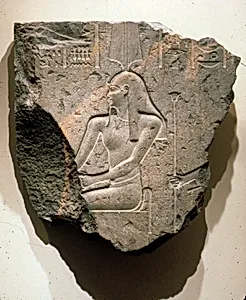
Seated Osiris-Anedjty
Unknown Artist
285–246 B.C. probably
Medium
Granodiorite
Dimensions
H. 71.5 × W. 71.8 cm (28 1/8 × 28 1/4 in.)
Classification
Relief, seated Osiris-Anedjty
Period
Ptolemaic Period
Department
Egyptian Art
Museum
Metropolitan Museum of Art, New York, NY
Credit
Rogers Fund, 1912
Accession Number
12.182.4a
Rights
Public Domain
Tags
Art Historical Context
Behold the **Seated Osiris-Anjty**, a commanding granite-like sculpture carved from granodiorite during Egypt's Ptolemaic Period (ca. 285–246 B.C.). This nearly life-sized figure (71.5 × 71.8 cm) captures the god Osiris in his syncretic form as Anedjty, the ram-headed deity linked to the city of Mendes. Acquired through the Rogers Fund in 1912, it now graces the Egyptian Art galleries at the Metropolitan Museum of Art. In the Ptolemaic erafollowing Alexander the Great's conquest, when Greek rulers adopted Egyptian traditions—such statues embodied divine kingship and the afterlife. Osiris, god of resurrection and fertility, was central to Egyptian beliefs, promising eternal renewal. The seated pose, rigid yet regal, reflects time-honored conventions: a frontal gaze, idealized proportions, and likely symbolic regalia evoking stability and power. Crafted from tough granodiorite, a stone prized for its durability and fine polish, the work showcases masterful Egyptian stoneworking techniques. Subtle modeling and surface sheen would have gleamed under temple lights, inviting worshippers to connect with the divine. This artifact bridges pharaonic piety and Hellenistic influence, offering a window into a vibrant cultural fusion.