
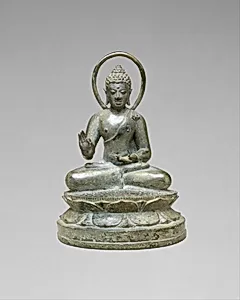
Seated Transcendent Buddha Vairochana
Unknown Artist
ca. late 9th century
Medium
Bronze
Dimensions
H. 7 5/8 in. (19.4 cm)
Classification
Sculpture
Culture & Period
Indonesia (Java) · Central Javanese period
Department
Asian Art
Museum
Metropolitan Museum of Art, New York, NY
Credit
Samuel Eilenberg Collection, Gift of Samuel Eilenberg, 1987
Accession Number
1987.142.23
Rights
Public Domain
Tags
Art Historical Context
This small bronze sculpture of the Seated Transcendent Buddha Vairochana dates to the late 9th century during Java’s Central Javanese period. Created in Indonesia, it represents Vairochana, one of the five cosmic Buddhas in Mahayana and Vajrayana traditions, often associated with the center of the universe and the embodiment of wisdom. The figure’s compact size—just under eight inches tall—suggests it may have served as a portable devotional object for personal worship or as part of a larger temple altar. During this era, Java was a flourishing center of Buddhist art and architecture, influenced by maritime trade networks connecting India, Southeast Asia, and China. The Central Javanese period produced monumental stone monuments like Borobudur, yet bronze works like this one highlight the period’s refined metalworking traditions. Skilled artisans cast these figures using lost-wax techniques, allowing for intricate details in the Buddha’s serene expression, robes, and mudras. As part of the Metropolitan Museum’s Samuel Eilenberg Collection, the sculpture offers visitors a glimpse into Java’s rich Buddhist heritage and the enduring appeal of Vairochana’s transcendent imagery across cultures.