
Secretary (sécretaire à abattant)
Unknown Artist
ca. 1815–20 with later additions
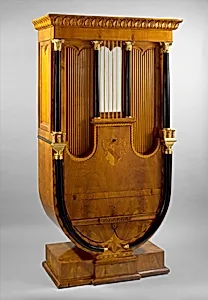
Medium
Walnut, parcel-ebonized and mounted with gilt bronze; leather, glass, brass
Dimensions
105 x 37 x 21 in. (266.7 x 94 x 53.3 cm)
Classification
Woodwork-Furniture
Culture
Austrian
Department
European Sculpture and Decorative Arts
Museum
Metropolitan Museum of Art, New York, NY
Credit
Gift of Frederich R. Koch, 1991
Accession Number
1991.470
Rights
Public Domain
Art Historical Context
This elegant *Secretary (sécre à abattant)*, crafted in Austria around 1815–20 with some later additions, exemplifies the refined furniture of the Biedermeier period—a time of post-Napoleonic following the Congress of Vienna. drop-front desk, standing over 8 feet tall, was designed for the burgeoning middle class, blending practicality with understated luxury. Its form allowed for discreet storage of papers and writing supplies, reflecting the era's emphasis on functional domestic spaces amid Austria's cultural and political resurgence. Made primarily from walnut, the piece features parcel-ebonizing—a technique where parts of the wood were painted black to imitate costly ebony—enhanced by ornate gilt bronze mounts, leather writing surfaces, glass panels, and brass hardware. These materials and methods highlight exceptional Viennese craftsmanship, where high-quality woods met subtle opulence, avoiding the excesses of earlier Empire styles. The gilt bronze accents, likely depicting neoclassical motifs, add a touch of grandeur to its otherwise sober lines. A generous gift to the Metropolitan Museum of Art from Frederick R. Koch in 1991, this secretary invites visitors to appreciate how everyday objects embodied 19th-century Austrian ingenuity, bridging utility and artistry in the home.