
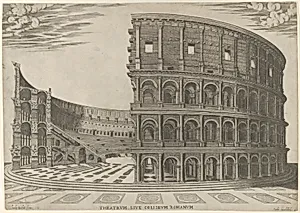
Section and elevation of the Colosseum in Rome
Medium
Etching
Dimensions
sheet: 15 1/4 x 21 5/8 in. (38.7 x 55 cm)
Classification
Prints
Department
Drawings and Prints
Museum
Metropolitan Museum of Art, New York, NY
Credit
Bequest of Phyllis Massar, 2011
Accession Number
2012.136.939
Rights
Public Domain
Tags
About this artwork
"Section and elevation of the Colosseum in Rome" by Giovanni Ambrogio Brambilla|Claudio Duchetti (Italian) from 1581 represents an important work in prints. Created in etching, this work demonstrates technical skill and artistic vision. As a print, it demonstrates reproductive techniques of the period. The artwork reflects aesthetic values of its time, offering insight into artistic practices and cultural context. It demonstrates the evolution of artistic expression and technical methods during ...
Art Historical Context
Step into the grandeur of ancient Rome through this meticulous 1581 etching, *Section and Elevation of the Colosseum in Rome*, created by Italian artists Giovanni Ambrogio Brambilla and Claudio Duchetti. Measuring an impressive 15¼ × 21⅝ inches, this print offers a precise architectural rendering—showing both a cross-section and exterior elevation—of the iconic Flavian Amphitheater, built in the 1st century AD. As part of the Metropolitan Museum of Art's Drawings and Prints collection (bequest of Phyllis Massar, 2011), it captures the Colosseum's multi-tiered arches, vaults, and seating in exquisite detail. Produced during the late Renaissance, when artists and architects like those in Rome's vibrant printmaking scene eagerly studied classical ruins, this work exemplifies reproductive print techniques. Etching, with its fine, fluid lines achieved by biting acid into metal plates, allowed for detailed dissemination of architectural knowledge—vital for scholars, builders, and travelers rediscovering antiquity. Brambilla's designs, often published by Duchetti, fueled the era's fascination with Roman engineering. Today, this print not only documents a wonder of the ancient world but also highlights 16th-century Italy's technical innovation and cultural reverence for the past, bridging eras for modern viewers.