
Section from a Qur'an Manuscript
Unknown Artist
ca. 1320
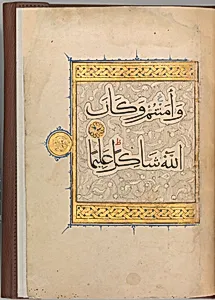
Medium
Main support: Ink, opaque watercolor, and gold on paper Binding: Leather; tooled
Dimensions
H. 10 7/16 in. (26.5 cm) W. 7 1/2 in. (19 cm)
Classification
Codices
Department
Islamic Art
Museum
Metropolitan Museum of Art, New York, NY
Credit
Purchase, Gifts in memory of Newton Foster, and funds from various donors, 2006
Accession Number
2006.212
Rights
Public Domain
Tags
Art Historical Context
This exquisite *Section from a Qur'an Manuscript*, dating to around 1320, offers a glimpse into the pinnacle Islamic calligraphy from the medieval period. Housed in the Metropolitan Museum of Art's Department of Islamic Art, thisex fragment measures a compact 10 7/16 by 7 1/2 inches, bound in tooled leather for protection and elegance. As a sacred text, it represents the Quran—the holy book of Islam—rendered with profound reverence by an unknown artist, highlighting the era's devotion to spiritual and aesthetic perfection. Crafted with ink, opaque watercolor, and gold on paper, the manuscript showcases masterful Kufic or early Naskh script, where flowing letters dance across the page. The lavish use of gold illumination not only elevates readability in low light but symbolizes divine light, a technique central to Islamic manuscript traditions. Opaque watercolors add vibrant diacritical marks and ornamental frames, blending functionality with artistry in a single, harmonious page. In Islamic culture, Qur'an manuscripts were among the most treasured artworks, often commissioned by rulers or scholars. This piece, acquired in 2006 through generous donations, underscores calligraphy's status as the noblest art form, where the word of God transcended mere text to become a visual prayer. Visitors, marvel at how every curve and gleam invites contemplation of faith and beauty.