
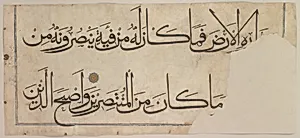
Section from the "Qur'an of `Umar Aqta'
late 14th–early 15th century (before 1405)
Medium
Ink, opaque watercolor, and gold on paper
Dimensions
H. 19 1/2 in. (49.5 cm) W. 43 5/8 in. (110.8cm)
Classification
Codices
Department
Islamic Art
Museum
Metropolitan Museum of Art, New York, NY
Credit
Gift of Samuel T. Peters, 1918
Accession Number
18.17.3
Rights
Public Domain
Tags
Art Historical Context
This exquisite section from the *Qur'an of `Umar Aqta'* showcases the masterful calligraphy of the artist `Umar Aqta' himself, dating to the late 14th early 15th centurybefore 1405). As a codex fragment from the Islamic world, it represents a sacred portion of the Qur'an, the holy book of Islam, rendered with profound reverence during a golden age of manuscript production. Such works were not merely texts but treasures, often commissioned by patrons to demonstrate piety and artistic patronage. Crafted in ink, opaque watercolor, and gold on paper, the piece measures an impressive 19½ by 43⅝ inches, allowing for grand, legible script ideal for communal recitation. The use of gold illumination—typical of high-end Qur'ans—elevates the verses, creating a luminous effect that symbolizes divine light. `Umar Aqta's calligraphy exemplifies the disciplined beauty of Islamic script traditions, where fluid lines and precise proportions convey spiritual harmony without figurative imagery. Housed in the Metropolitan Museum of Art's Department of Islamic Art (gift of Samuel T. Peters, 1918), this fragment invites visitors to appreciate the cultural pinnacle of Qur'anic art: a fusion of faith, skill, and splendor that bridged medieval Islamic centers of learning.