
Segovia Bridge, Madrid
1924
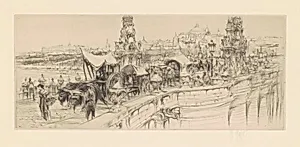
Medium
drypoint in black on laid paper
Dimensions
plate: 14.92 × 34.93 cm (5 7/8 × 13 3/4 in.) sheet: 25.72 × 43.18 cm (10 1/8 × 17 in.)
Classification
Department
CG-W
Museum
National Gallery of Art, Washington, D.C.
Credit
Corcoran Collection (Gift of E. Gerald Lamboley)
Accession Number
2015.19.2987
Rights
Public Domain
Art Historical Context
William Walcot's *Segovia Bridge, Madrid*1924) captures the majestic Roman aqueduct—known as the Puente del Acueducto—in Segovia, Spain, a UNESCO World Heritage site and engineering marvel from the 1st or 2nd century AD. This drypoint etching showcases Walcot's expertise as a British architect-turned-printmaker (1874–1943), who traveled Europe in the early 20th century, rendering iconic landmarks with architectural precision during the etching revival period. His works blend technical mastery with a romantic appreciation for historic structures, evoking the grandeur of ancient Rome amid modern interwar Europe. Executed in drypoint on laid paper, the technique involves scratching directly into a metal plate, raising a soft burr that produces richly textured, velvety lines—ideal for conveying the aqueduct's towering granite arches and dramatic shadows. Measuring 14.92 × 34.93 cm on the plate, this intimate yet expansive view invites viewers to trace the bridge's rhythmic repetition, highlighting Walcot's skill in light, texture, and depth. Housed in the National Gallery of Art's Corcoran Collection (Gift of E. Gerald Lamboley), it exemplifies the era's fascination with printmaking as a democratic art form, preserving architectural wonders for posterity.