
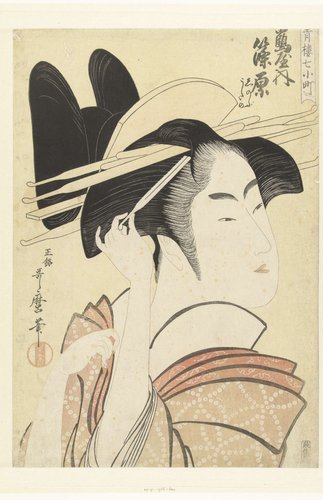
Seiro nana Komachi
1795 - 1800
Medium
color woodcut
Dimensions
254; 364
Rights
Public Domain
About this artwork
height 364 mm x width 254 mm
Art Historical Context
**Seiro Nana Komachi** is a captivating color woodcut by Kitagawa Utamaro, one of the foremost masters of ukiyo-e ("pictures of the floating world") from late 18th-century Japan. Created between 1795 and 1800, this print belongs to a series that portrays seven courtesans from the Yoshiwara district in Edo (modern Tokyo), each likened to Ono no Komachi—a legendary Heian-era poetess famed for her ethereal beauty and tragic love stories. Measuring 364 mm high by 254 mm wide, it exemplifies Utamaro's signature bijin-ga style, celebrating the elegance and allure of women with exquisite detail. Utamaro's work captures the vibrant cultural life of Edo's entertainment quarters during the Edo period (1603–1868), where woodblock prints democratized art for the urban merchant class. These images elevated courtesans as modern muses, blending fantasy with realism to reflect societal fascinations with beauty, transience, and pleasure—core themes of ukiyo-e. The color woodcut technique shines here: artisans carved separate blocks for each hue, layering vibrant pigments like vermilion and Prussian blue for luminous effects. Utamaro's innovative use of subtle gradations (bokashi) and delicate lines brought unprecedented lifelike quality to prints, influencing global art from Japonisme to Impressionism. A treasure of Japanese printmaking, it invites visitors to ponder timeless ideals of grace amid fleeting joys.
About the Artist
Kitagawa Utamaro · 1753–1806
Kitagawa Utamaro (c. 1753-1806) was one of the most celebrated masters of ukiyo-e woodblock printing, revolutionizing the art of bijin-ga (pictures of beautiful women) during Japan's Edo period. Born Kitagawa Ichitaro, his early life remains shrouded in mystery, with conflicting accounts placing his birth in Kyoto, Osaka, Yoshiwara in Edo (modern Tokyo), or Kawagoe in Musashi Province. Under the t...