
Selbstbildnis 1919 (Self-Portrait 1919)
1919
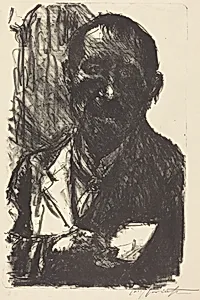
Medium
lithograph in black
Dimensions
plate: 39.6 x 25.4 cm (15 9/16 x 10 in.) sheet: 50 x 32.5 cm (19 11/16 x 12 13/16 in.)
Classification
Department
CG-W
Museum
National Gallery of Art, Washington, D.C.
Credit
Gift of Jacob Kainen
Accession Number
2002.98.268
Rights
Public Domain
Art Historical Context
**Selbstbildnis 1919 (Self-Portrait 1919 by Lovis Corinth captures the artist in his late years through the intimate medium of black lithograph. Created in 1919, this measures 39.6 x 25.4 cm on the plate, with a larger sheet of 50 x 32.5 cm. Corinth, a leading German painter and printmaker, was renowned for his bold, expressive style that bridged Impressionism and Expressionism. By this time, he had suffered a stroke in 1911, and his self-portraits often reflected a raw vulnerability, confronting age, illness, and mortality with unflinching honesty. Lithography, a planographic printing technique invented in the late 18th century, allowed Corinth to achieve rich tonal contrasts and fluid lines directly from stone or metal plates—ideal for his dynamic mark-making. This self-portrait exemplifies his mastery of the medium, producing editions that made his work accessible beyond original paintings. Produced amid the turmoil of post-World War I Germany, it resonates as a personal meditation during the Weimar Republic's cultural ferment. Housed in the National Gallery of Art's Prints department (CG-W) as a gift from Jacob Kainen, this piece invites visitors to ponder Corinth's enduring legacy: over 100 self-portraits that humanize the artist's physical decline while celebrating his unyielding creative spirit. A poignant window into early 20th-century Expressionism.
About the Artist
Lovis Corinth · 1858–1925
Lovis Corinth, born Franz Heinrich Louis on July 21, 1858, in Tapiau, East Prussia (now Gvardeysk, Russia), to a tanner father, displayed prodigious drawing talent from childhood. He began formal training at the Königsberg Academy in 1876, then moved to the Academy of Fine Arts in Munich from 1880 to 1884, studying under Ludwig von Löfftz and briefly Franz von Defregger, where he absorbed a Realis...