
Selbstbildnis (Self-Portrait)
1920
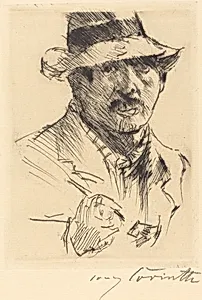
Medium
drypoint in black on laid paper
Dimensions
plate: 11.9 x 8.8 cm (4 11/16 x 3 7/16 in.) sheet: 23.2 x 17.1 cm (9 1/8 x 6 3/4 in.)
Classification
Department
CG-W
Museum
National Gallery of Art, Washington, D.C.
Credit
Gift of the Marcy Family in memory of Sigbert H. Marcy
Accession Number
1991.243.21
Rights
Public Domain
Art Historical Context
Lovis Corinth's *Selbstbildnis* (Self-Port) of 1920 captures the German artist's unflinching gaze in his final years. A master of Impressionism and Expressionism, produced over 100 self-portraits throughout his career, using them as a mirror to explore aging, illness, and the human spirit. By 1920, two decades after his Impressionist beginnings and nearly a decade after a debilitating stroke in 1911, his style had evolved into bold, expressive strokes reflecting personal vulnerability and artistic resilience. Rendered in drypoint—a direct intaglio technique where the artist scratches lines into a copper plate, producing a soft, velvety burr for rich tonal depth—this intimate print measures just 11.9 x 8.8 cm on laid paper. Drypoint's immediacy suited Corinth's late manner, allowing spontaneous, textured marks that convey psychological intensity on a small scale. The modest sheet size (23.2 x 17.1 cm) enhances its personal, almost confessional quality. Housed in the National Gallery of Art's Department CG-W as a gift from the Marcy Family, this work exemplifies Corinth's printmaking prowess amid Weimar Germany's cultural ferment, bridging 19th-century traditions with modernist introspection. Visitors will appreciate its raw honesty—a poignant testament to an artist's enduring self-examination.
About the Artist
Lovis Corinth · 1858–1925
Lovis Corinth, born Franz Heinrich Louis on July 21, 1858, in Tapiau, East Prussia (now Gvardeysk, Russia), to a tanner father, displayed prodigious drawing talent from childhood. He began formal training at the Königsberg Academy in 1876, then moved to the Academy of Fine Arts in Munich from 1880 to 1884, studying under Ludwig von Löfftz and briefly Franz von Defregger, where he absorbed a Realis...