
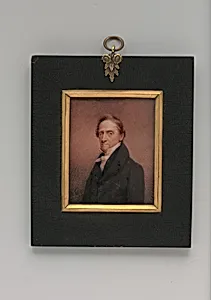
Self-portrait
ca. 1825
Medium
Watercolor on ivory
Dimensions
3 x 2 in. (7.6 x 5.1 cm)
Classification
Painting, miniature
Culture
American
Department
The American Wing
Museum
Metropolitan Museum of Art, New York, NY
Credit
Dale T. Johnson Fund, 2004
Accession Number
2004.117a, b
Rights
Public Domain
Tags
Art Historical Context
William Dunlap's *Self-Portrait* (ca. 1825) captures the artist in a diminutive yet intimate format, measuring just 3 x 2 inches (7.6 x 5.1 cm). Rendered in watercolor on ivory, this miniature exemplifies a cherished 19th-century American tradition where portraits were created small enough to fit into lockets, brooches, or pocket cases—personal talismans for loved ones. Ivory's luminous, pearl-like surface allowed for exquisite detail and subtle color gradations, making it ideal for conveying lifelike expressions and textures in a jewel-like scale. As a pioneering figure in American art and theater, Dunlap (1766–1839)—often called the "father of the American stage"—painted this self-portrait during a formative era for U.S. cultural identity, post-Revolution and amid growing national pride. Housed in The Metropolitan Museum of Art's American Wing, it reflects early 19th-century portraiture's focus on realism and individualism, influenced by British miniaturists like those of the Cosway school. Dunlap's introspective gaze underscores his multifaceted career as painter, playwright, and historian, chronicling America's nascent art scene. This delicate work invites visitors to ponder the artist's self-perception at mid-life, blending technical virtuosity with personal revelation in a format that once traveled close to the heart.