
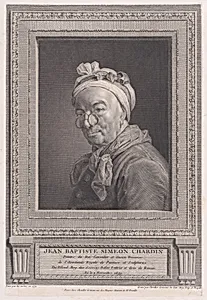
Self-portrait
Medium
Engraving
Dimensions
Image: 12 5/8 x 8 3/4 in. (32.1 x 22.2 cm) Sheet: 13 1/8 x 8 3/4 in. (33.3 x 22.3 cm)
Classification
Prints
Department
Drawings and Prints
Museum
Metropolitan Museum of Art, New York, NY
Credit
Harris Brisbane Dick Fund, 1953
Accession Number
53.600.541
Rights
Public Domain
Tags
Art Historical Context
This exquisite engraving, titled *Self-Portrait*, captures the likeness of Jean Siméon Ch, one of 18th-century's most revered painters, rendered by engraver Justus Chev after 1771. Measuring about 12⅝ × 8¾ inches, it hails from the Metropolitan Museum of Art Drawings and Prints collection, through the Harris Brisbane Dick Fund in1953. Chardin, known for his masterful still lifes and intimate genre scenes in the Rococo style, here presents himself with quiet dignity, a hallmark of his realistic approach to everyday subjects. Created as a reproductive print, this work exemplifies the artistry of engraving—a meticulous intaglio technique where lines are incised into a metal plate, inked, and pressed onto paper to produce richly detailed images. Chevillet's skilled translation preserved Chardin's subtle modeling and textured surfaces, making the master's visage accessible beyond original paintings. Such prints were vital in the Enlightenment era, democratizing art by circulating portraits of luminaries among collectors and admirers. Chardin's late self-portrait reflects his enduring legacy at the Académie Royale, where he bridged opulent Rococo elegance with proto-modern realism. This piece invites visitors to ponder the engraver's craft and the intimate vulnerability of an artist gazing back at his own life’s work.
About the Artist
Jean Siméon Chardin|Justus Chevillet|Justus Chevillet · 1699–1779
Jean-Baptiste-Siméon Chardin, born on November 2, 1699, in Paris to a cabinetmaker father who crafted billiard tables, grew up immersed in the city's artisan world on the Left Bank near Saint-Sulpice. His early training came through apprenticeships with the history painters Pierre-Jacques Cazes, where he honed academic drawing techniques, and Noël-Nicolas Coypel, whose assignment to copy a musket ...