
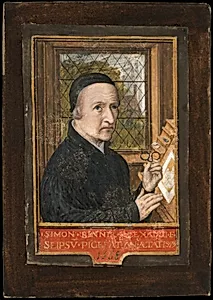
Self-portrait
1558
Medium
Tempera and gold leaf on parchment
Dimensions
3 3/8 x 2 1/4 in. (8.5 x 5.7 cm)
Classification
Manuscripts and Illuminations
Department
Robert Lehman Collection
Museum
Metropolitan Museum of Art, New York, NY
Credit
Robert Lehman Collection, 1975
Accession Number
1975.1.2487
Rights
Public Domain
Tags
Art Historical Context
Nestled within the opulent Robert Lehman Collection at the Metropolitan Museum of Art Simon Bening's *Self-Portrait* (1558) is a exquisite gem of Northern Renaissance illumination. Bening, a master Flemish miniaturist from Bruges (c. 1483–1561), was the last great practitioner of the Netherlandish manuscript tradition, succeeding his father, Simon Marmion. At just 3⅜ × 2¼ inches, this tiny work on parchment captures the artist's likeness with astonishing precision, likely originating from a luxurious Book of Hours or prayer book intended for elite patrons. Crafted in tempera and gold leaf—the hallmarks of illumination—Bening employs vibrant, opaque pigments for lifelike facial details and burnished gold to evoke a divine glow, mimicking the sheen of larger panel paintings in miniature form. Self-portraits in manuscripts were rare, making this a poignant assertion of the artist's identity amid the decline of illumination as printing rose. Completed near the end of Bening's career, it reflects his unparalleled skill in rendering depth and personality on an intimate scale. This work highlights the cultural prestige of illuminated manuscripts in 16th-century Europe, where such books blended devotion, artistry, and status. Visitors are invited to marvel at how Bening compressed a lifetime of mastery into a space smaller than a modern postcard.