
Self-Portrait
1887
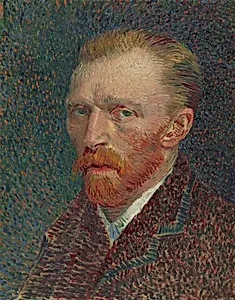
Medium
Oil on artist's board, mounted on cradled panel
Dimensions
41 × 32.5 cm (16 1/8 × 12 13/16 in.); Framed: 61.6 × 53.4 × 8.9 cm (24 1/4 × 21 × 3 1/2 in.)
Classification
oil on board
Department
Painting and Sculpture of Europe
Museum
Art Institute of Chicago
Accession Number
80607
Rights
Public Domain
About this artwork
In 1886 Vincent van Gogh left his native Holland and settled in Paris, where his beloved brother Theo was a dealer in paintings. Van Gogh was apparently inspired by the energy of the city and by his introduction to Impressionism, and he created at least twenty-four self-portraits during his two-year stay in the French capital. This early example is modest in size and was painted on prepared artist’s board rather than canvas. Its densely dabbed brushwork, which became a hallmark of Van Gogh’s st...
Art Historical Context
Vincent van Gogh's *Self-Portrait* (1887) invites visitors into the artist's introspective world during his transformative Paris years. Created when Van Gogh was experimenting with urban influences and brighter palettes, this work captures his shift toward Post-Impressionism, marked by expressive brushwork and emotional intensity. Lacking funds for professional models, Van Gogh frequently turned to self-portraits—over 30 in total—making this a poignant example of his resourceful ingenuity. Painted in oil on an artist's board and mounted on a cradled panel for durability, the compact 41 × 32.5 cm canvas emphasizes intimacy and portability, ideal for Van Gogh's peripatetic life. The modest medium allowed bold, direct application of color and texture, hallmarks of his emerging style that rejected academic polish in favor of raw vitality. Housed in the Art Institute of Chicago's Department of Painting and Sculpture of Europe, this classification as "oil on board" underscores its technical innovation. It offers a window into Van Gogh's psyche on the cusp of his Arles period, reminding us of his enduring legacy as a pioneer of modern expression.
About the Artist
Vincent van Gogh · 1853–1890
Vincent Willem van Gogh (1853-1890) stands as one of the most influential figures in Western art history, despite a career spanning merely a decade. Born in Groot-Zundert, Netherlands, to a Protestant pastor's family, van Gogh's path to artistic greatness was anything but conventional. His early adulthood saw him working as an art dealer for Goupil & Cie, a language teacher, and a fervent missiona...