
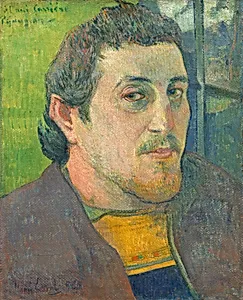
Self-Portrait Dedicated to Carrière
1888 or 1889
Medium
oil on canvas
Dimensions
overall: 46.5 x 38.6 cm (18 5/16 x 15 3/16 in.) framed: 66 x 58.7 x 8.2 cm (26 x 23 1/8 x 3 1/4 in.)
Classification
Painting
Department
CF
Museum
National Gallery of Art, Washington, D.C.
Credit
Collection of Mr. and Mrs. Paul Mellon
Accession Number
1985.64.20
Rights
Public Domain
Art Historical Context
In the late 1880s, Paul Gauguin, a pioneering Post-Impressionist, captured his intense gaze in *Self-Portrait Dedicated to Carrière* (1888 or 1889), an oil on canvas measuring 46.5 x 38.6 cm. This intimate work pays homage to Eugène Carrière, a fellow French artist known for his soft, mystical portraits. Gauguin inscribed the dedication on the canvas, reflecting a moment of artistic camaraderie amid his restless search for new expressive forms. Painted during his time in Brittany, it marks his shift from Impressionism toward Synthetism—a bold style emphasizing flat color planes, strong outlines, and symbolic depth over naturalistic detail. Gauguin's technique here is strikingly direct: heavy contours frame his face like stained glass, while vibrant yet subdued hues evoke inner turmoil and exotic reverie. Self-portraits were a staple for Gauguin, serving as personal manifestos of his evolving identity as he rejected bourgeois life for primal inspiration. This piece foreshadows his later voyages to Tahiti and embrace of Primitivism. Now in the National Gallery of Art's collection, gifted by Mr. and Mrs. Paul Mellon, it invites visitors to ponder Gauguin's unyielding vision—a bridge between 19th-century Europe and the modern avant-garde.
About the Artist
Paul Gauguin · 1848–1903
Paul Gauguin (1848-1903) was a French Post-Impressionist painter whose bold experiments with color, form, and subject matter made him one of the most influential figures in the transition from 19th-century art to modernism. His rejection of European civilization for the perceived authenticity of 'primitive' cultures established an archetype of artistic exile that continues to resonate. Gauguin's ...