
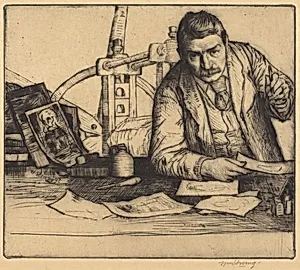
Self-Portrait
1897
Medium
drypoint
Dimensions
sheet: 22.8 × 25.6 cm (9 × 10 1/16 in.)
Classification
Department
CG-E
Museum
National Gallery of Art, Washington, D.C.
Credit
Rosenwald Collection
Accession Number
1943.3.7996
Rights
Public Domain
Art Historical Context
William Strang's *Self-Portrait* (7) captures the Scottish artist's introspective gaze in a striking drypoint print, measuring a intimate 22.8 × 256 cm. Created during late Victorian era, when printmaking flourished as an accessible medium for personal expression, this work exemplifies Strang's mastery as a leading British etcher of his time. A member of the Royal Society of Painter-Etchers Strang drew inspiration from masters like Rembrandt, infusing his portraits with psychological depth and realism. Drypoint, the technique used here, involves scratching directly into a copper plate with a sharp needle, raising a soft burr that holds ink and produces richly textured, velvety lines. Unlike smoother etching processes, drypoint's immediate, tactile quality allowed Strang to convey subtle nuances of expression and texture—evident in the fine lines defining his features and the subtle modeling of his face. This self-portrait highlights the medium's potential for intimate, spontaneous artistry, bridging traditional portraiture with modern print innovation. Housed in the National Gallery of Art's Rosenwald Collection, renowned for its exceptional prints, this piece reflects the fin de siècle revival of original printmaking. Strang's unflinching self-examination underscores a broader cultural fascination with individuality amid rapid social change, inviting viewers to ponder the artist's inner world through his masterful lines.