
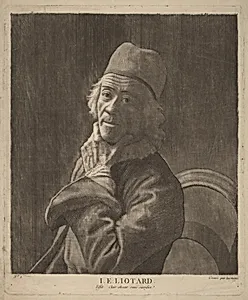
Self-Portrait
1778/1780
Medium
roulette and engraving over mezzotint on laid paper
Dimensions
image: 43.3 × 37.7 cm (17 1/16 × 14 13/16 in.) plate: 48 × 40 cm (18 7/8 × 15 3/4 in.) sheet: 53.5 × 43.2 cm (21 1/16 × 17 in.)
Classification
Department
CG-E
Museum
National Gallery of Art, Washington, D.C.
Credit
Rosenwald Collection
Accession Number
1953.6.78
Rights
Public Domain
Art Historical Context
Step into the refined world of 18th-century portraiture Jean-Étienne Liard's *Self-Portrait* (1778/1780), a captivating print from the National Gallery Art's Rosenwald Collection Liotard, a Swiss artist celebrated for his meticulous pastel portraits and Rococo elegance, crafted this image late in his career, capturing his own likeness with the unflinching realism that defined his style. Having traveled extensively—from Paris to Constantinople and London—Liotard brought an international flair to his work, Eastern influences with Western precision. This artwork showcases innovative printmaking: a mezzotint base provides velvety tonal depths mimicking oil painting's luminosity, enhanced by roulette—a wheeled tool for textured shading—and fine engraving lines for crisp details, all on laid paper. At nearly 17 by 15 inches, it exemplifies how prints democratized art, allowing collectors beyond the elite to own a piece of Liotard's genius. Produced in his later years (he lived until 1789), it reflects Enlightenment-era self-reflection, where artists asserted their identity amid shifting cultural tides. A gem in the Prints department, this self-portrait invites visitors to ponder Liotard's enduring legacy: a master who painted Turkish sultanas, British nobility, and himself with equal candor, bridging eras through technical virtuosity.
About the Artist
Jean-Étienne Liotard · 1692–1789
Comment on works: Portraits