
Self-Portrait
c. 1780
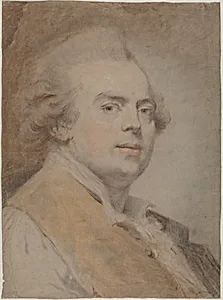
Medium
red and black chalks, and pastel with stumping on gray-brown laid paper
Dimensions
overall: 51 x 37.5 cm (20 1/16 x 14 3/4 in.)
Classification
Drawing
Department
CG-E
Museum
National Gallery of Art, Washington, D.C.
Credit
Woodner Collection
Accession Number
1998.17.4
Rights
Public Domain
Art Historical Context
Claude Hoin's *Self-Portrait* (c. 1780) captures the artist in a moment of introspective intensity, rendered with masterful finesse on gray-brown laid paper. Measuring 51 x 37.5 cm, this drawing exemplifies late 18th-century French draughtsmanship during the waning years of the Ancien Régime, a time when artists like Hoin blended Rococo elegance with emerging Neoclassical restraint. As a lesser-known but skilled pastellist and portraitist, Hoin used this intimate self-study to showcase his technical prowess, inviting viewers to ponder the personal gaze behind the public facade. The medium—red and black chalks combined with pastel and stumping—reveals innovative techniques for achieving subtle tonal gradations and lifelike flesh tones. Stumping, the process of blending pigments with a soft leather tool, creates velvety transitions that mimic the softness of skin and fabric, a hallmark of preparatory studies for larger portraits. This layered approach not only highlights Hoin's command of mixed media but also underscores the drawing's autonomy as a finished work, prized for its psychological depth. Housed in the National Gallery of Art's Woodner Collection (Department CG-E), this piece offers a window into the private world of 18th-century artists, where self-portraits served as both professional calling cards and personal meditations. A gem for drawing enthusiasts, it celebrates the enduring power of chalk and paper to convey human vulnerability.