
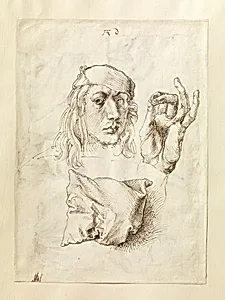
Self-portrait, Study of a Hand and a Pillow (recto); Six Studies of Pillows (verso)
Albrecht Dürer, 1493
About this artwork
Created in 1493 when Albrecht Dürer was just 20 years old, this double-sided drawing on the recto features a striking self-portrait of the artist's head with shoulder-length, paired with an outsized hand dramatically posed as if grasping an invisible pen, and study of a pillow below. The verso showcases six meticulous pillow studies. Executed in pen and brown, it served as vital preparation for Dürer's painted *Self-Portrait* of the same year, now the Louvre—one of the earliest independent self-portraits Western painting, marking a bold shift toward personal expression in Northern Renaissance art. These studies highlight Dürer's prodigious draftsmanship and observational prowess. The hand conveys tension and purpose, symbolizing the artist's own creative act, while the pillow exercises masterfully capture the interplay of light and shadow on drapery folds—a core tradition in artistic training. Such preparatory works reveal Dürer's methodical process, blending precise linework with naturalistic detail. As a cornerstone of the Robert Lehman Collection at the Metropolitan Museum of Art, this piece captures a pivotal moment in Dürer's career. He would go on to become the Northern Renaissance's greatest printmaker, bridging Italian Renaissance ideals like anatomical precision and humanism with German traditions, profoundly influencing European art.