
Self-Portrait with Raised Sabre
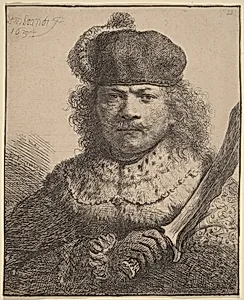
Medium
etching with touches of drypoint on laid paper
Dimensions
sheet (trimmed within plate mark): 12.2 x 9.9 cm (4 13/16 x 3 7/8 in.)
Classification
Department
CG-E
Museum
National Gallery of Art, Washington, D.C.
Credit
Rosenwald Collection
Accession Number
1943.3.7257
Rights
Public Domain
Art Historical Context
In 1634, at the height of his early career in Amsterdam, Rembrandt van Rijn created *Self-Portrait with Raised Sabre*, a striking etching with subtle touches of drypoint on laid paper. Measuring just 12.2 x 9.9 cm, this intimate print captures the artist in a dynamic, almost theatrical pose—brandishing a sabre with fierce intensity, his face shadowed yet boldly lit. Rembrandt, a master of the Dutch Golden Age and Baroque style, produced over 80 self-portraits throughout his life, using them to explore identity, emotion, and light with unparalleled psychological depth. The medium is key to its brilliance: etching allowed precise, fluid lines etched by acid into a copper plate, while drypoint added rich, velvety burrs from direct needle scratches, creating dramatic contrasts and textures. This innovative combination elevated printmaking from reproductive tool to expressive art form, influencing generations. Printed on laid paper with its characteristic chain lines, the work feels alive, as if Rembrandt's energy bursts from the small sheet. Housed in the National Gallery of Art's Rosenwald Collection (Department CG-E), this piece exemplifies Rembrandt's bravura in capturing raw power and self-assurance. Visitors are drawn to its immediacy—a bold declaration of artistic prowess amid the 17th-century Dutch Republic's cultural flourishing.
About the Artist
Rembrandt van Rijn · 1606–1669
Rembrandt Harmenszoon van Rijn (1606–1669) stands as one of the greatest visual artists in the history of Western art and the most important Dutch painter of the 17th century. Born in Leiden to a prosperous miller's family, Rembrandt transformed painting through his revolutionary use of light and shadow, his psychological depth in portraiture, and his elevation of etching to a fine art. His approx...