
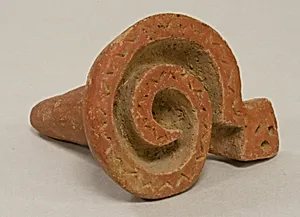
Serpent Stamp
Unknown Artist
1st–7th century
Medium
Ceramic
Dimensions
H. 2 1/16 x W. 2 1/8 in. (5.3 x 5.4 cm)
Classification
Ceramics-Implements
Culture
Atlantic Watershed
Department
Arts of Africa, Oceania, and the Americas
Museum
Metropolitan Museum of Art, New York, NY
Credit
The Michael C. Rockefeller Memorial Collection, Bequest of Nelson A. Rockefeller, 1979
Accession Number
1979.206.1183
Rights
Public Domain
Tags
Art Historical Context
This petite ceramic Serpent Stamp, crafted by an unknown artist from the Atlantic Watershed culture between the 1st and 7th centuries, exemplifies ingenuity of pre-Columb artisans in what is now Colombia's Caribbean. Measuring just over 2 inches in height and width, this delicate implement—housed in The Metropolitan Museum of Art's Michael C. Rockefeller Memorial Collection likely used to press intricate designs onto the body, textiles, or unfired clay, a common practice in ancient American societies for ritual decoration or everyday adornment. The stamp's central motif, a sinuous serpent, holds profound cultural resonance. In Atlantic Watershed ceramics, serpents often symbolized water, fertility, and the earth's regenerative forces, reflecting the region's lush riverine environment and spiritual worldview. Hand-modeled and incised with fine details, the piece showcases sophisticated low-fired clay techniques that allowed for portability and durability, blending utility with symbolic artistry. As a rare survivor from daily life, this stamp offers a window into the vibrant, interconnected world of early Atlantic Watershed peoples, where art and function intertwined seamlessly. Visitors, imagine its cool clay surface leaving bold, ephemeral impressions—echoes of ancient stories stamped into the skin of time.