
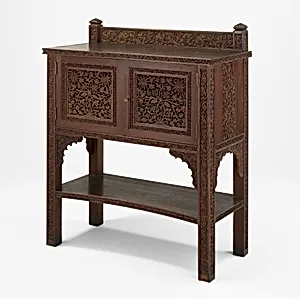
Server
c. 1880–90
Medium
Carved teakwood, ash or oak
Dimensions
119.4 × 48.3 × 99.7 cm (47 × 19 × 39 1/4 in.)
Classification
furniture
Department
Arts of the Americas
Museum
Art Institute of Chicago
Accession Number
181453
Rights
Public Domain
About this artwork
During the Aesthetic movement of the late 19th century, American designers’ fascination with the exotic led them to explore the art of India. On a trip to that country in 1880–81, Lockwood de Forest became interested in traditional Indian wood carving and established his own wood and metal workshop in Ahmedabad, India, to promote the native craft revival. Back in New York, he incorporated panels and architectural elements carved in the workshop into the furniture and interiors he designed for th...
Art Historical Context
Lockwood de Forest’sServer,” made around 1880–189, captures the late-nenth-century American fascination global materials and decorative traditions Classified among the Arts of the Americas at Art Institute of Chicago, piece was designed for practical use in a dining or parlor while serving as a showcase of fine carving. Its modest scale—roughly 47 by19 by 39¼ inches—made suitable for the well-appointed homes of the. The work is fashioned primarily from carved teakwood, accented with ash or oak. Teak’s dense grain and natural oils lent both strength and a warm, lustrous surface ideal for intricate relief carving. Such furniture often reflected the Aesthetic Movement’s emphasis on beauty in everyday objects, blending sturdy American construction with exotic woods that spoke to expanding trade routes and cultural curiosity. De Forest’s choice of medium and form highlights a moment when American makers looked beyond domestic traditions, creating pieces that were at once functional and quietly cosmopolitan. Today the server invites visitors to appreciate how a single object can embody both utility and the artistic exchanges of its era.
About the Artist
Lockwood de Forest · 1850–1932
American painter, interior designer and furniture designer. A key figure in the Aesthetic Movement, he introduced the East Indian craft revival to Gilded Age America. His father was Henry Grant de Forest, and his son worked professionally as Lockwood de Forest, Jr., though the son's birth name is Lockwood de Forest, III.