
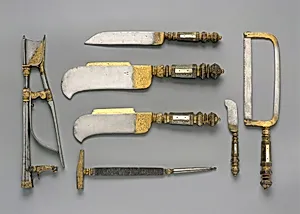
Set of seven pruning tools
Unknown Artist
1575–1600
Medium
Steel, partly gilded; mother-of-pearl
Dimensions
Overall (tool .1470): 3 5/16 × 5/8 × 12 in. (8.4 × 1.6 × 30.5 cm); Overall (knife .1471): 1 × 6 5/8 × 7 in. (2.5 × 16.8 × 17.8 cm); Overall (knife .1472): 1 1/4 × 1 × 12 in. (3.2 × 2.5 × 30.5 cm); Overall (saw .1473): 3 1/8 × 13 3/4 × 1 1/8 in. (7.9 × 34.9 × 2.9 cm) Overall (clippers .1474): 3 9/16 × 13 1/8 × 1 1/16 in. (9 × 33.3 × 2.7 cm); Overall (knife .1475): 2 7/8 × 1 3/8 × 12 3/4 in. (7.3 × 3.5 × 32.4 cm); Overall (knife .1476): 3 1/8 × 1 1/2 × 14 in. (7.9 × 3.8 × 35.6 cm)
Classification
Metalwork-Steel
Culture
French, Moulins
Department
European Sculpture and Decorative Arts
Museum
Metropolitan Museum of Art, New York, NY
Credit
Gift of Irwin Untermyer, 1964
Accession Number
64.101.1470–.1476
Rights
Public Domain
Art Historical Context
This exquisite set of seven pruning tools, crafted in Moulins, France, between 1575 and 1600, offers a rare glimpse into the Renaissance fusion of functionality and luxury. Ranging from compact knives to larger clippers and a saw, each tool varies in size—from a slender 3 5/16-inch pruner to a 14-inch blade—designed for precise garden work like trimming vines or shaping ornamental plants. Housed in the Metropolitan Museum of Art's European Sculpture and Decorative Arts collection, this gift from Irwin Untermyer in 1964 highlights the era's sophisticated metalwork traditions. Made of steel, partially gilded for a golden sheen, and inlaid with lustrous mother-of-pearl, these tools transcend mere utility. Gilding protected the steel while adding opulence, and the iridescent shell inlays—sourced from distant seas—demonstrate masterful techniques in chasing, engraving, and inlaying. Such embellishments suggest they belonged to elite gardeners or nobility, reflecting France's growing passion for formal gardens during the late 16th century, a time when humanism and natural sciences flourished. These implements from Moulins, a hub of fine craftsmanship, embody the Renaissance ideal of beauty in everyday objects. Far from rustic farm tools, they invite us to appreciate how even pruning shears could be jewels of artistry, blending practicality with the period's love for ornate decoration.