
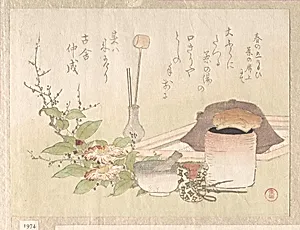
Set of Utensils for the Tea Ceremony
1810s
Medium
Woodblock print (surimono); ink and color on paper
Dimensions
5 7/16 x 7 1/4 in. (13.8 x 18.4 cm)
Classification
Prints
Culture & Period
Japan · Edo period (1615–1868)
Department
Asian Art
Museum
Metropolitan Museum of Art, New York, NY
Credit
H. O. Havemeyer Collection, Bequest of Mrs. H. O. Havemeyer, 1929
Accession Number
JP1974
Rights
Public Domain
Tags
Art Historical Context
Kubo Shunman's *Set of Utensils the Tea Ceremony* (1810s) is a delicate woodblock known as a *surimono*, a, privately commissioned format popular in Japan's Edo period (1615–1868). just 5 7/16 x 7 1/4 inches, this intimate work captures the refined tools of *chanoyu*, the Japanese tea ceremony—ladles, whisks, and containers—adorned with blooming flowers that evoke seasonal beauty and impermanence. Shunman, a master of ukiyo-e printmaking, blended poetry and artistry in these bespoke pieces, often produced for New Year's greetings or poetry circles. Surimono like this one stand out for their superior craftsmanship: vibrant inks, subtle colors, and sometimes embossed effects on fine paper, making them collector's treasures rather than mass-produced images. During the Edo era, the tea ceremony embodied Zen principles of harmony, respect, purity, and tranquility (*wa, kei, sei, jaku*), transforming everyday utensils into symbols of spiritual ritual. Flowers in the design highlight *wabi-sabi* aesthetics—celebrating nature's fleeting elegance. Housed in the Metropolitan Museum of Art's H. O. Havemeyer Collection, this print offers a window into 19th-century Japan's cultured elite, where art and ceremony intertwined to foster mindfulness amid urban bustle. A perfect gem for contemplating simplicity's profound depth.
About the Artist
Kubo Shunman 窪俊満 (Japanese) · 1757 –1820
Japanese, 1757–1820