
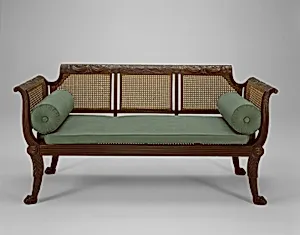
Settee
1815–20
Medium
Mahogany with caning and upholstery
Dimensions
90.2 × 183.3 × 58.4 cm (35 1/2 × 72 3/8 × 23 in.)
Classification
seating
Department
Arts of the Americas
Museum
Art Institute of Chicago
Accession Number
52743
Rights
Public Domain
Art Historical Context
Nestled in the Arts of the Americas collection at Art Institute of Chicago, this elegant settee from 1815–20 exemplifies 19th-century American furniture craftsmanship. Crafted by unknown artist, its generous dimensions—90.2 × 183.3 × 58.4 cm—make it a welcoming centerpiece for parlors, designed for comfortable seating with supportive arms and a spacious bench-like form. Dating to the post-War of 1812 era, it reflects the young United States' embrace of neoclassical ideals, evoking the symmetry and refinement of ancient forms adapted for everyday life. The settee's mahogany frame, prized for its rich reddish-brown hue and durability, highlights the era's reliance on imported tropical hardwoods from the Caribbean and Central America, symbols of transatlantic trade and prosperity. Delicate caning—woven rattan or similar reeds—provides breathable support in the back and sides, a practical technique borrowed from European designs that promoted airflow in humid climates. Luxurious upholstery completes the piece, inviting layered cushions for lounging or conversation. As a prime example of Federal-style seating, this settee underscores the artistry of anonymous workshops in cities like New York or Philadelphia, blending utility with understated elegance. Visitors, imagine hosting intimate gatherings here— a testament to America's emerging cultural confidence!