
Settee
c. 1936
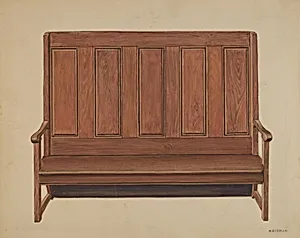
Medium
watercolor, colored pencil, graphite, and heightening on paperboard
Dimensions
overall: 23 x 28.3 cm (9 1/16 x 11 1/8 in.) Original IAD Object: 50 3/4"high; 61 3/4"wide; 15 3/4"deep at seat
Classification
Index of American Design
Department
CG-W
Museum
National Gallery of Art, Washington, D.C.
Credit
Index of American Design
Accession Number
1943.8.5431
Rights
Public Domain
Art Historical Context
Behold the exquisite rendering of a *Settee* by Harry Eisman, around 1936 as part of the Index of American Design (IAD). This watercolor, colored pencil, graphite, and heightening on paperboardmeasuring 23 x 28.3 cm—captures the elegance of a classic American sofa, originally standing 50 3/4 inches high, 61 3/4 inches wide, and15 3/4 inches deep at the seat. Housed in the National Gallery of, it exemplifies the IAD's mission to document the nation's folk and decorative arts heritage. Born during the Great Depression as a Federal Art Project under the Works Progress Administration (1935–1942), the IAD employed artists like Eisman to produce thousands of precise, colorful plates of everyday objects, from furniture to quilts. This settee depiction preserves a slice of American craftsmanship, likely from the 18th or 19th century, highlighting the graceful curves and sturdy proportions that defined period interiors. Eisman's masterful use of layered media brings the wood grain, upholstery textures, and subtle shadows to life, with heightening adding luminous highlights for depth and realism. Such techniques not only served as archival records but also celebrated the artistry in ordinary American design, making cultural treasures accessible to future generations. A testament to ingenuity amid hardship, this work invites us to appreciate the beauty in our shared history.
About the Artist
Harry Eisman · 1855–present
Harry Eisman is an artist about whom the historical record remains sparse, and reliable details regarding his dates, nationality, and training have not been firmly established in available scholarship. The works associated with his name suggest engagement with the graphic arts or printmaking traditions, though the full scope of his career and artistic interests is difficult to characterize without...