
Settee (one of a pair) (part of a set)
ca. 1763–64
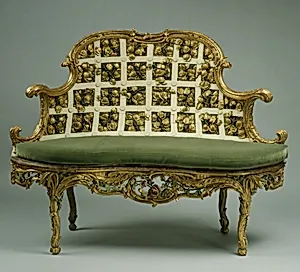
Medium
Carved, painted and gilded linden wood; squab pillow in silk velvet (not original)
Dimensions
43 x 54 1/2 x 25 1/4 in. (109.2 x 138.4 x 64.1cm)
Classification
Woodwork-Furniture
Culture
German, Würzberg
Department
European Sculpture and Decorative Arts
Museum
Metropolitan Museum of Art, New York, NY
Credit
The Lesley and Emma Sheafer Collection, Bequest of Emma A. Sheafer, 1973
Accession Number
1974.356.121a
Rights
Public Domain
Tags
Art Historical Context
This exquisite settee, crafted by Johann Michael Bauer around 1763–64 in Würzburg, Germany, the opulent Rococo style that flourished in southern Germany during the mid-18th century. of a matching pair and part of a larger set, it was designed for intimate parlors or boudoirs, where its graceful curves and lavish ornamentation would have dazzled visitors. Measuring 43 x 54½ x 25¼ inches, the piece invited leisurely lounging, its form blending functionality with fantasy. Bauer, a master sculptor from Würzburg, skillfully carved lightweight linden wood into blooming floral motifs—evident in the tags associating it with flowers—before painting and gilding the surfaces for a shimmering, jewel-like effect. This technique not only highlighted the intricate details but also evoked the natural world's exuberance, a hallmark of Rococo's playful asymmetry and organic forms. The modern silk velvet squab pillow enhances its comfort, though it replaces the original upholstery. Housed in The Metropolitan Museum of Art's European Sculpture and Decorative Arts department through the Lesley and Emma Sheafer Collection (1973), this settee offers a glimpse into princely courts like that of the Würzburg bishops, where furniture doubled as sculpture. Its survival underscores the enduring allure of German craftsmanship from the Age of Enlightenment.