
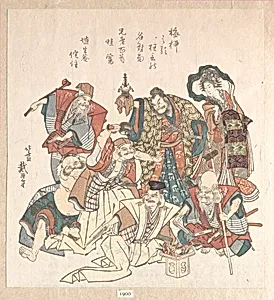
Seven Gods of Good Fortune
1808–27
Medium
Woodblock print (surimono); ink and color on paper
Dimensions
8 1/4 x 7 1/2 in. (21 x 19.1 cm)
Classification
Prints
Culture & Period
Japan · Edo period (1615–1868)
Department
Asian Art
Museum
Metropolitan Museum of Art, New York, NY
Credit
H. O. Havemeyer Collection, Bequest of Mrs. H. O. Havemeyer, 1929
Accession Number
JP1900
Rights
Public Domain
Tags
Art Historical Context
Katsushika Hokus's *Seven Gods of Good Fortune created between 1808 and1827, captures the joyful essence of Japan's beloved Shichifukujin—the seven deities who sail the seas in a treasure ship, bestowing blessings like longevity, wealth, and happiness This intimate woodblock print, known as *surimono*, was commissioned for private celebrations, such as New Year's greetings, showcasing Hokusai's mastery of ukiyo-e, the "pictures of the floating world" that celebrated everyday beauty and folklore during the Edo period (1615–1868). Measuring just 8¼ x 7½ inches, this ink and color print on paper exemplifies the technical brilliance of woodblock printing: intricate carving allowed for vibrant hues, subtle gradients, and fine details crammed into a compact format. Hokusai, famed for iconic works like *The Great Wave*, infused the scene with dynamic energy, blending men and women deities in harmonious revelry—a nod to the era's prosperous urban culture in Edo (modern Tokyo). Housed in the Metropolitan Museum of Art's Asian Art Department from the H.O. Havemeyer Collection, this piece highlights the cultural reverence for these gods, who symbolized hope amid life's uncertainties. A delightful window into 19th-century Japanese artistry, it reminds us that good fortune, like art, thrives in shared wonder.
About the Artist
Katsushika Hokusai · 1760–1849
Katsushika Hokusai (1760-1849) stands as one of history's most influential artists, a Japanese master who revolutionized the ukiyo-e woodblock print tradition and profoundly shaped Western art. Born in the Katsushika district of Edo (modern-day Tokyo) to an artisan family, Hokusai lived through nearly nine decades of extraordinary creative evolution, adopting over thirty different artistic names t...