
Sewing Bird
c. 1936
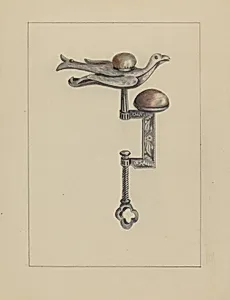
Medium
graphite and colored pencil on paper
Dimensions
overall: 23 x 17.6 cm (9 1/16 x 6 15/16 in.)
Classification
Index of American Design
Department
CG-W
Museum
National Gallery of Art, Washington, D.C.
Credit
Index of American Design
Accession Number
1943.8.13470
Rights
Public Domain
Art Historical Context
**Sewing Bird***Charlotte Winter, c. 1936* Graphite and colored pencil on, 23 x 17.6 cm *Index of American Design, National Gallery of Art* into the charming world of American folk craft with Charlotte Winter's delicate rendering of a "Sewing Bird a whimsical 19th-century tool shaped like a perched bird. Crafted from graphite and colored pencil on paper, this small-scale drawing (just 9 x 7 inches) captures the object's intricate details—the clamped beak holding fabric taut for sewers, its hinged tail, and polished metal sheen brought to life through subtle shading and vibrant hues. Winter's precise technique highlights the everyday ingenuity of American homemakers, turning a practical device into an artistic treasure. Created around 1936 as part of the Index of American Design—a Works Progress Administration (WPA) project during the Great Depression—this artwork preserves vanishing folk traditions. Sponsored by the Federal Art Project, the Index commissioned over 15,000 such renderings by artists nationwide to document regional crafts, fostering national pride in American heritage amid economic hardship. Winter's contribution underscores the cultural role of sewing tools in colonial and frontier life, where "sewing birds" symbolized thrift and creativity. Today, housed in the National Gallery of Art, this piece invites us to appreciate how humble objects reflect broader stories of resilience and design innovation. A delightful glimpse into history's quiet heroes! (198 words)
About the Artist
Charlotte Winter · 1855–present
Charlotte Winter was an American artist who made her most lasting contribution during the late 1930s and early 1940s as a participant in the Index of American Design, a major New Deal program administered under the Works Progress Administration's Federal Art Project. The Index employed artists across the United States to document the nation's decorative arts heritage through meticulous watercolor ...