
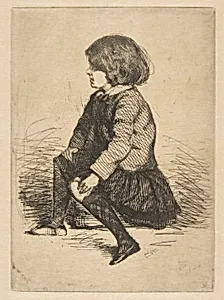
Seymour Seated
1857–58
Medium
Etching, printed in black ink on fine buff Japan; third state of three (Glasgow)
Dimensions
plate: 5 5/16 x 3 13/16 in. (13.5 x 9.7 cm) sheet: 6 5/16 x 4 3/4 in. (16 x 12.1 cm)
Classification
Prints
Department
Drawings and Prints
Museum
Metropolitan Museum of Art, New York, NY
Credit
Harris Brisbane Dick Fund, 1917
Accession Number
17.3.24
Rights
Public Domain
Tags
Art Historical Context
James McNeill Whistler’s “Seymour Seated” is an intimate etching created between 1857 and 1858, early in the artist’s career. At this time Whistler was exploring printmaking while living between Paris and London, using the medium to capture quiet, everyday moments with remarkable sensitivity. The subject, a young girl named Seymour, is shown seated in a simple pose that emphasizes natural grace over formal portraiture. Printed in black ink on fine buff Japan paper, this impression represents the third and final state of the plate. Etching allowed Whistler to achieve delicate lines and subtle tonal effects that suited his emerging interest in atmosphere and restraint. The small scale—roughly five by four inches—invites close viewing, rewarding the observer with the quiet details of the sitter’s posture and expression. Acquired by the Metropolitan Museum of Art through the Harris Brisbane Dick Fund in 1917, the print highlights Whistler’s lifelong commitment to the etching tradition. Works such as this one helped establish his reputation as a master of the medium, demonstrating how modest subjects could carry lasting artistic significance.
About the Artist
James McNeill Whistler · 1834–1903
James Abbott McNeill Whistler (1834-1903) was an American-born painter and printmaker who became a leading figure in the Aesthetic Movement and pioneer of Tonalism and Japonisme. He revolutionized art by championing "art for art's sake" and treating paintings as visual equivalents of musical compositions, titling works as "arrangements," "harmonies," and "nocturnes" to emphasize formal qualities o...