
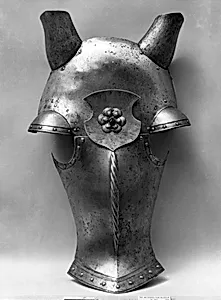
Shaffron (Horse's Head Defense)
Unknown Artist
ca. 1520
Medium
Steel
Dimensions
H. 26 in. (66 cm); W. 15 1/2 in. (39.4 cm); D. 7 in. (17.8 cm); Wt. 4 lb. 6 oz. (1984.5 g)
Classification
Equestrian Equipment-Shaffrons
Culture
German
Department
Arms and Armor
Museum
Metropolitan Museum of Art, New York, NY
Credit
Gift of Prince Albrecht Radziwill, 1927
Accession Number
27.183.37
Rights
Public Domain
Art Historical Context
Step into the world of Renaissance chivalry with this striking *Shaffron (Horse's Head Defense)*, crafted around 1520 by an unknown German armorer. Fashioned from steel, this protective piece shields a warhorse's face during jousts and battles, curving elegantly to fit the contours of the animal's head. Measuring 26 inches high, 15½ inches wide, and just 7 inches deep, weighs a mere 4 pounds 6 ounces—lightweight engineering that balanced protection with the horse's mobility on the battlefield. In early 16th-century Germany, amid the height of the Holy Roman Empire's knightly traditions, shaffrons like this were essential equestrian gear. Horses were prized assets in warfare and tournaments, often more valuable than their riders' lives, so such armor underscored the era's blend of martial prowess and status display. The steel's forged construction reflects masterful metallurgical skill, hammered to withstand lances while allowing visibility through strategic openings. Today, this gem graces the Metropolitan Museum of Art's Arms and Armor Department, a generous 1927 gift from Prince Albrecht Radziwill. It invites us to ponder the human-horse partnership that defined medieval combat, where beauty met brutality in gleaming metal.