
Shaffron (Horse's Head Defense)
Unknown Artist
early 16th century
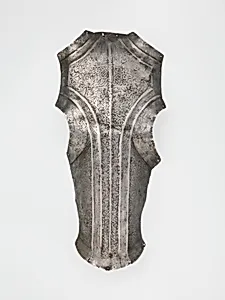
Medium
Steel, copper alloy
Dimensions
H. 20 in. (50.8 cm); W. 9 1/2 in. (24.1 cm); Wt. 1 lb. 11 oz. (735 g)
Classification
Equestrian Equipment-Shaffrons
Culture
Turkish or Iranian
Department
Arms and Armor
Museum
Metropolitan Museum of Art, New York, NY
Credit
Bequest of George C. Stone, 1935
Accession Number
36.25.510
Rights
Public Domain
Art Historical Context
Step into the world of early 16th-century warfare this striking shaffron, a protective head armor for warhorses, crafted by an unknown Turkish or Iranian artist. Dating to around 1520–1530, this piece from the Metropolitan Museum of Art's Arms and Department exemplifies the vital role of equestrian equipment in the cavalry-dominated battles of the Ottoman Empire or Safavid Persia. Shaffrons like this shielded a horse's face from arrows, blades, and lances, ensuring the rider's mobility and survival on the battlefield. Forged from lightweight steel reinforced with copper alloy, the shaffron measures just 20 inches high and weighs only 1 lb. 11 oz., a testament to the masterful metalworking techniques of Islamic artisans. Its form-fitting design contours to the horse's head, with precise perforations for eyes, ears, and nostrils—balancing protection with breathability and vision. Such innovations highlight the blend of functionality and artistry in Near Eastern arms, where horse and rider formed an inseparable unit of power. Bequeathed to the Met in 1935 by George C. Stone, this shaffron invites us to ponder the thunder of hooves across vast steppes, a symbol of martial prowess and cultural exchange along the Silk Road. Though battle-worn in imagination, it endures as a finely wrought relic of a bygone era.