
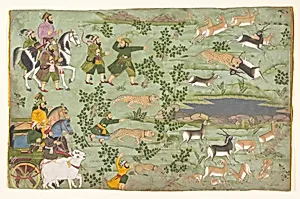
Shah Jahan Hunting Blackbuck with Trained Cheetahs
Unknown Artist
1710–15
Medium
Ink, gold, and opaque watercolor on paper
Dimensions
10 7/8 x 16 5/8 in. (27.6 x 42.2 cm)
Classification
Paintings
Culture
Western India, Rajasthan, Udaipur
Department
Asian Art
Museum
Metropolitan Museum of Art, New York, NY
Credit
Gift of Cynthia Hazen Polsky, in celebration of the Museum’s 150th Anniversary, 2019
Accession Number
2019.445.2
Rights
Public Domain
Art Historical Context
This vibrant painting from Udaipur, Rajasthan, Mughal Emperor Shah Jahan (r. 1628–58) in a dynamic hunting scene with trained cheetahs pursuing blackbuck antelope. Created around 1710–15 by an unknown artist in the Mewar school of Rajput painting, it the refined miniature tradition of Western India. Rendered in ink, gold, and opaque watercolor paper (10 7/8 x 16 5/8 in.), the work showcases meticulous detailing, with gold accents highlighting the emperor's regal attire and the animals' fluid motion against a stylized landscape. Hunting scenes like this were popular in Rajput courts, blending Mughal influences with local styles to celebrate imperial prowess and nobility. Cheetahs, tamed for centuries in South Asia to hunt swift prey like blackbucks, symbolized royal power and mastery over nature—Shah Jahan himself was renowned for such spectacles. Though painted decades after his reign, it reflects enduring admiration for his legacy during Udaipur's artistic golden age under Maharana Sangram Singh II. A gift to the Metropolitan Museum of Art in 2019, this piece invites viewers into the opulent world of 18th-century Indian courts, where art immortalized the thrill of the chase and the splendor of empire.