
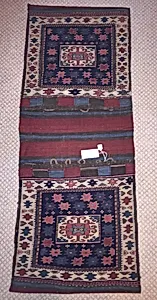
Shahsevan Double Saddle Bag
Unknown Artist
ca. 1850
Medium
Wool and cotton
Dimensions
H. 51 in. (129.5 cm) W. 21 in. (53.3 cm)
Classification
Textiles
Department
Islamic Art
Museum
Metropolitan Museum of Art, New York, NY
Credit
Gift of Inger G. and William B. Ginsberg, 2018
Accession Number
2018.666.15
Rights
Public Domain
Art Historical Context
This striking Shahsevan double saddle bag, dating to around 1850, exemplifies masterful textile traditions of nomadic peoples in northwestern Iran. Crafted by an unknown artist from the Shahvan tribe—a Turkic-speaking confederacy renowned for their pastoral lifestyle—the bag was designed as a practical khorjin, or paired pouch, for securing goods on horseback during migrations. Measuring an impressive 51 inches high and 21 inches wide, its wool and cotton construction reflects the resourcefulness of nomads who wove these essentials by hand, balancing utility with bold aesthetic appeal. In the context of 19th-century Islamic art, such saddle bags were more than mere baggage; they were cultural artifacts encoding tribal identity through intricate patterns and dyes derived from local plants. The flatweave technique, likely slit tapestry or kilim, allowed for vibrant, geometric motifs that symbolized protection, fertility, and status—hallmarks of Shahsevan craftsmanship. These pieces bridged daily life and artistry, transforming functional objects into portable heirlooms. Now housed in the Metropolitan Museum of Art's Islamic Art Department, thanks to a 2018 gift from Inger G. and William B. Ginsberg, this saddle bag invites visitors to envision the rhythmic journeys of Iran's nomadic past, where every knot told a story of resilience and beauty.