
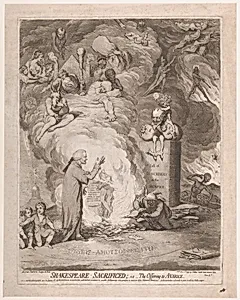
Shakespeare – Sacrificed; or, The Offering to Avarice
June 20, 1789
Medium
Etching and aquatint; undescribed state
Dimensions
image: 18 5/8 x 14 15/16 in. (47.3 x 37.9 cm) plate: 19 13/16 x 15 1/4 in. (50.3 x 38.8 cm) sheet: 21 15/16 x 17 3/8 in. (55.7 x 44.1 cm)
Classification
Prints
Department
Drawings and Prints
Museum
Metropolitan Museum of Art, New York, NY
Credit
The Elisha Whittelsey Collection, The Elisha Whittelsey Fund, 1962
Accession Number
62.600.759
Rights
Public Domain
Tags
Art Historical Context
Step into the sharp-witted world of James Gill, the preeminent British caricaturist of the late 18th century, with *Shakespeare – Sacrificed; or, The Offering to Avarice (1789). This etching and aquatint print, measuring nearly 19 by 15 inches, skewers the commercialization of culture through biting satire. Gillray, master of exaggerated features and dark humor, depicts William Shakespeare—England's literary giant—as a sacrificial victim to "Avarice," personified greed, likely critiquing theater managers, publishers, or speculators who profited ruthlessly from the Bard's enduring plays amid London's bustling cultural scene. Created just as the French Revolution ignited Europe, the work reflects anxieties over moral decay and exploitation in Georgian Britain. Gillray's technique blends precise etching lines for crisp details with aquatint's subtle tonal washes, evoking shadowy drama and heightening the grotesque comedy. Published by James Aitken, it exemplifies the era's booming print market, where such affordable satires shaped public opinion. Housed in the Metropolitan Museum of Art's Elisha Whittelsey Collection, this undescribed state print remains a testament to Gillray's genius in wielding art as a weapon against vice, reminding us how Shakespeare's legacy has long tempted the avaricious.