
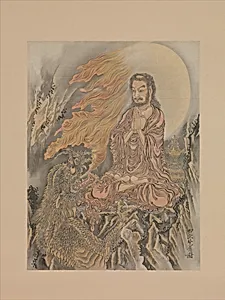
釈迦降魔図|Shakyamuni Subjugating Demons
ca. 1888
Medium
Album leaf mounted as a hanging scroll; ink and color on silk
Dimensions
14 1/2 x 11 in. (36.8 x 27.9 cm)
Classification
Paintings
Culture & Period
Japan · Meiji period (1868–1912)
Department
Asian Art
Museum
Metropolitan Museum of Art, New York, NY
Credit
Charles Stewart Smith Collection, Gift of Mrs. Charles Stewart Smith, Charles Stewart Smith Jr., and Howard Caswell Smith, in memory of Charles Stewart Smith, 1914
Accession Number
14.76.61.51
Rights
Public Domain
Tags
Art Historical Context
In the late Meiji period (1868–1912), as Japan navigated rapid modernization, artist Kawanabe Kyōsai crafted *Shakyamuni Subjugating Demons* around 1888. Known as the "Demon Painter Kyōsai blended traditional Japanese ink painting with whimsical, satirical flair, drawing from ukiyo-e folk art traditions. This intimate album leaf, mounted as a hanging scroll in ink and color on silk (14½ × 11 in.), exemplifies his dynamic style—bold brushstrokes and vivid hues capturing supernatural energy on a luxurious, shimmering surface. The scene depicts Shakyamuni Buddha triumphing over marauding demons, a classic Buddhist motif symbolizing enlightenment's victory over ignorance and temptation. Dragons and fierce yokai (supernatural creatures) swirl around the serene Buddha, embodying Japan's rich fusion of Shinto animism and Buddhist iconography. Kyōsai's playful exaggeration infuses the spiritual narrative with humor and vitality, reflecting Meiji-era tensions between ancient beliefs and Western influences. Once part of the Charles Stewart Smith Collection, this Met masterpiece highlights Kyōsai's mastery in small-scale formats, where every swirling line pulses with life. A testament to enduring Japanese artistic ingenuity amid change.
About the Artist
Kawanabe Kyōsai 河鍋暁斎 (Japanese) · 1831 –1889
Japanese, 1831–1889