
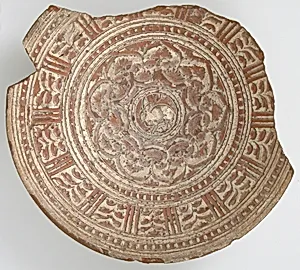
Shallow Dish fragment
Unknown Artist
12th–13th century
Medium
Earthenware with sgraffito slip, glaze
Dimensions
Overall: 1 9/16 x 7 7/8 x 7 1/16 in. (4 x 20 x 18 cm)
Classification
Ceramics
Culture
Byzantine
Department
Medieval Art
Museum
Metropolitan Museum of Art, New York, NY
Credit
Purchase, 1901
Accession Number
01.32
Rights
Public Domain
Art Historical Context
This delicate fragment of a shallow dish hails from the Byzantine Empire during the 12th–13th centuries, a golden age of medieval artistry when Constantinople was a thriving crossroads of trade and culture Crafted from earthenware this everyday vessel offers a glimpse into domestic life, where ceramics like these graced tables in homes and monasteries across the eastern Mediterranean. Acquired by the Metropolitan Museum of Art through purchase in 1901 it now resides in the Medieval Art department, preserving a piece of this vibrant heritage. The dish's standout feature is its sgraffito technique—a masterful method where artisans applied a slip (liquid clay) over the earthenware body, then scratched intricate designs through it to reveal the contrasting clay beneath, before adding a clear glaze for shine and protection. This labor-intensive process created bold, textured patterns, often geometric or floral, blending functionality with subtle elegance. Though only a fragment survives (measuring about 1 9/16 x 7 7/8 x 7 1/16 inches), it exemplifies Byzantine ceramic innovation, influenced by Islamic and Persian neighbors yet distinctly imperial in style. Byzantine pottery like this bridged utility and art, exported widely and reflecting the empire's resilience amid Crusades and conquests. Imagine it holding olives or sweets— a testament to a sophisticated society where even tableware told stories of skill and cultural exchange.