
Shard
Unknown Artist
ca. 4th–5th century
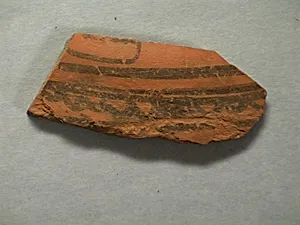
Medium
Painted terracotta
Dimensions
H. 1 1/8 in. (2.0 cm); W. 2 7/8 in. (7.3 cm); D. 3/8 in. (1 cm)
Classification
Ceramics
Culture
Pakistan
Department
Asian Art
Museum
Metropolitan Museum of Art, New York, NY
Credit
Seymour Fund, 1992
Accession Number
1992.271.32
Rights
Public Domain
Tags
Art Historical Context
This delicate shard of painted terracotta, hailing from the Gandhara region of ancient Pakistan around the 4th–5th century, offers a glimpse into the vibrant ceramic traditions of early medieval South Asia. Measuring just over 2 inches wide, this tiny fragment—likely part of a larger vessel, plaque, or architectural tile—exemplifies the everyday artistry of a culture at the crossroads of empires. Acquired by the Metropolitan Museum of Art through the Fund in 1992, it resides in the Asian Art department, among ceramics that bridge utility and aesthetic beauty. Gandhara, straddling modern Pakistan and Afghanistan, was a melting pot of Greco-Roman, Persian, and Indian influences following Alexander the Great's campaigns and the Kushan Empire's heyday. Painted terracotta like this was a favored medium for decorating homes, temples, and Buddhist stupas, with pigments applied post-firing to capture vivid motifs—though this shard's specific imagery remains a tantalizing mystery. Its survival speaks to the durability of terracotta, fired clay that preserved cultural narratives through centuries of trade, religion, and conflict. For visitors, this unassuming piece underscores Gandhara's legacy as a cradle of hybrid art, where Hellenistic realism met Buddhist iconography, influencing everything from sculptures to pottery. A humble survivor, it invites us to ponder the skilled hands that painted it amid a thriving ancient world.