
Shard
Unknown Artist
ca. 4th–5th century
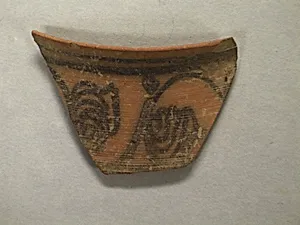
Medium
Painted terracotta
Dimensions
H. 1 1/2 in. (3.8 cm); W. 2 1/8 in. (5.4 cm); D. 1/2 in. (1.3 cm)
Classification
Ceramics
Culture
Pakistan
Department
Asian Art
Museum
Metropolitan Museum of Art, New York, NY
Credit
Seymour Fund, 1992
Accession Number
1992.271.23
Rights
Public Domain
Tags
Art Historical Context
This delicate painted terracotta shard, hailing from the Gandhara region of ancient Pakistan around the 4th–5th century CE, offers a tantalizing glimpse into a vibrant crossroads of cultures. Measuring just 1 1/2 inches high, it is a fragment likely from a larger ceramic vessel, plaque, or architectural element. Gandhara, straddling modern-day Pakistan and Afghanistan, was a hub of the Kushan Empire, where Greek, Roman, Persian, and Indian influences fused, most famously in Buddhist art. Though small, this shard exemplifies the everyday artistry of the era, preserved through the Seymour Fund at The Metropolitan Museum of Art. The use of terracotta—fired clay—painted with pigments was a practical yet expressive medium in Gandhara, allowing for intricate designs on pottery, figurines, and temple decorations. While the exact imagery on this shard isn't specified, such pieces often featured floral motifs, deities, or narrative scenes reflecting Buddhist themes or daily life. Its survival speaks to the region's skilled potters, who balanced durability with aesthetic appeal amid trade routes like the Silk Road. As a window into pre-Islamic South Asian ceramics, this unassuming fragment highlights Gandhara's legacy of cultural synthesis, bridging Hellenistic realism with indigenous spirituality. Visitors, imagine holding a piece of history from an empire that shaped early global art!