
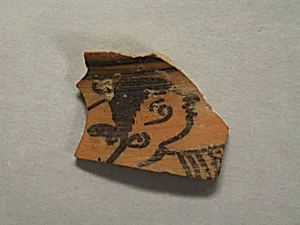
Shard: Head of Figure
Unknown Artist
ca. 4th–5th century
Medium
Painted terracotta
Dimensions
1 1/2 x 1 5/8 in. (3.8 x 4.1 cm)
Classification
Ceramics
Culture
Pakistan
Department
Asian Art
Museum
Metropolitan Museum of Art, New York, NY
Credit
Gift of Andrew Hale and Kate Fitz Gibbon, 1992
Accession Number
1992.256.36
Rights
Public Domain
Tags
Art Historical Context
This delicate shard, titled *Head of Figure*, is a fragment of painted terracotta from ancient Gandhara, a culturally rich region in present-day Pakistan, dating to around the 4th–5th century CE. Measuring just 1 1/2 x 1 5/8 inches, it once formed part of a larger ceramic figure, likely used in religious or domestic contexts. Now housed in the Metropolitan Museum of Art's Art Department as a gift from Andrew Hale Kate Fitz Gibbon in 1992, it offers a glimpse into the everyday artistry of a pivotal era. Gandhara flourished as a crossroads of Greek, Persian, and Indian influences following Alexander the Great's conquests, producing iconic Buddhist sculptures with realistic, classical features. Though this piece is a humble terracotta fragment rather than grand stone carving, its painted surface—vibrant colors applied to fired clay—highlights accessible artistic techniques favored by local artisans. Such small-scale ceramics were common for votive offerings or architectural decoration, bridging elite temple art with popular devotion. Its survival as a shard underscores the fragility of ancient artifacts, yet it speaks volumes about Gandhara's enduring legacy in ceramics. Visitors can appreciate how even tiny remnants preserve the spiritual and aesthetic world of early medieval South Asia.