
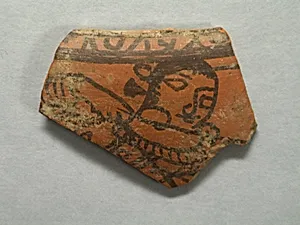
Shard: Head of Offerer
Unknown Artist
ca. 4th–5th century
Medium
Painted terracotta
Dimensions
2 1/2 x 2 1/8 in. (6.4 x 5.4 cm)
Classification
Ceramics
Culture
Pakistan
Department
Asian Art
Museum
Metropolitan Museum of Art, New York, NY
Credit
Gift of Andrew Hale and Kate Fitz Gibbon, 1992
Accession Number
1992.256.33
Rights
Public Domain
Tags
Art Historical Context
Nestled in the Metropolitan Museum of Art's Asian collection, this delicate *Shard: Head of Offerer* a painted terracotta fragment from ancient Pakistan, dating to around the 4th–5th century. Measuring just 2½ x 2⅛ inches, it captures the serene face of a devotee or worshiper, likely part of a larger votive figure or architectural ornament. Gifted in 1992 by Andrew Hale and Kate Fitz Gib, this tiny ceramic piece offers an intimate glimpse into everyday artistry from the Gandhara region. Gandhara, straddling modern Pakistan and Afghanistan, was a vibrant crossroads of cultures during this era, blending Hellenistic realism—introduced via Alexander the Great's legacy—with budding Buddhist iconography. Heads like this one often adorned shrines or stupas, depicting offerers in ritual devotion, their expressive features highlighting the region's innovative fusion of Greek naturalism and South Asian spirituality. Crafted in terracotta, a fired clay medium prized for its affordability and paintability, the shard's surviving pigmentation hints at vibrant colors that once animated sacred scenes. Though fragmented, it underscores the accessibility of religious art in ancient Gandhara, inviting us to ponder the hands that molded and painted it over 1,500 years ago.