
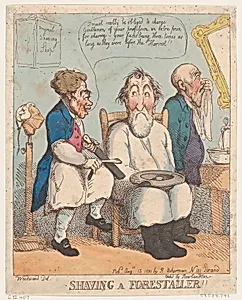
Shaving a Forestaller
Medium
Hand-colored etching
Dimensions
Sheet (trimmed): 11 1/4 × 9 1/16 in. (28.6 × 23 cm)
Classification
Prints
Department
Drawings and Prints
Museum
Metropolitan Museum of Art, New York, NY
Credit
The Elisha Whittelsey Collection, The Elisha Whittelsey Fund, 1959
Accession Number
59.533.741
Rights
Public Domain
Tags
Art Historical Context
"Shaving a Forestall," a hand-colored etching from August15, 1800, captures the sharp wit of British satirical art during the Regency era. Created artist George Murgatroyd Woodward, with contributions from caricaturist Thomas Rowlandson and publisher Rudolph Ackermann of London, this print exemplifies the vibrant world of early 19th-century humor. Measuring about 11¼ × 9 inches, it was produced as part of Ackermann's famed Repository of Arts, which popularized affordable, colorful prints for a wide audience. The title refers to a "forestaller"—a market manipulator who bought up goods to inflate prices, a practice outlawed in Britain to protect consumers. Here, the scene humorously depicts the punishment of such a rogue, with exaggerated figures undergoing a comical "shaving," a trope in caricatures symbolizing public humiliation. Rowlandson's dynamic style, full of bustling energy and grotesque features, amplifies the satire, while hand-coloring adds vivid life to the chaos, making it a standout example of the etching technique's role in mass-producing political and social commentary. Housed in the Metropolitan Museum of Art's Drawings and Prints department, this work highlights the cultural role of caricature in critiquing economic vices amid Napoleonic-era tensions. It invites visitors to chuckle at timeless follies while appreciating how prints democratized art and discourse in Georgian London.
About the Artist
George Murgatroyd Woodward|Rudolph Ackermann, London|Thomas Rowlandson · 1765–1809
**George Murgatroyd Woodward (1765–1809)**, often known as George “Moutard” or “Mustard” Woodward, was an English caricaturist and humor writer whose energetic, sometimes crude drawings captured the social follies of late Georgian Britain. Born at Stanton Hall in Stanton by Dale, Derbyshire, as the son of William Woodward, he grew up in the county before moving to London around 1791–92. Woodward ...