
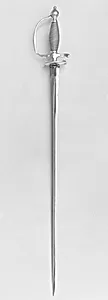
Sheath
1700–1800
Medium
Silver
Dimensions
Dimensions unavailable
Classification
Sheath
Culture
American
Department
The American Wing
Museum
Metropolitan Museum of Art, New York, NY
Credit
Bequest of Alphonso T. Clearwater, 1933
Accession Number
33.120.499b
Rights
Public Domain
Art Historical Context
Nestled in The Metropolitan Museum of Art's American Wing, *Sheath* is a crafted silver object attributed to Edward Winslow, a prominent Boston silversmith active in the late 17th and early 18th. Dating to the 1700–1800 period, this piece exemplifies the exquisite metalwork of colonial America, where silver served as a symbol of wealth, status, and craftsmanship among the elite. Winslow, whose family had deep roots in early New England, mastered techniques like chasing, repoussé, and engraving, creating functional yet elegant items for everyday use and display. As a sheath—likely for a knife or blade—this silver artifact highlights the silversmith's skill in producing durable, decorative accessories that blended utility with artistry. In an era before widespread industrialization, such objects were heirlooms, passed down through generations and reflecting the owner's social standing. Bequeathed to the Met in 1933 by Alphonso T. Clearwater, *Sheath* offers a tangible link to America's formative years, showcasing the ingenuity of colonial artisans who drew inspiration from English and European traditions while forging a distinct American identity in decorative arts. Visitors can appreciate how this unassuming yet masterful piece captures the refinement of 18th-century life.