
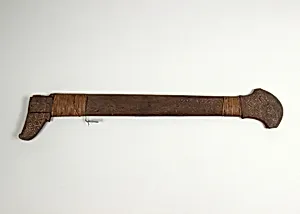
Sheath for a Kris
Unknown Artist
18th–19th century
Medium
Wood, cane (rattan)
Dimensions
L. 25 1/8 in. (63.8 cm); W. 4 1/2 in. (11.4 cm); Wt. 8.8 oz. (249.5 g)
Classification
Krisses
Culture
Philippine
Department
Arms and Armor
Museum
Metropolitan Museum of Art, New York, NY
Credit
Bequest of George C. Stone, 1935
Accession Number
36.25.1638
Rights
Public Domain
Art Historical Context
This elegant sheath for a kris, crafted in the Philippines during the 18th–19th, exemplifies the fusion of functionality and artistry in Southeast Asian. The kris, a wavy-bladed dagger revered by warriors and chieftains, held deep cultural significance among Filipino communities, particularly the Moro people of Mindanao. Often more than a weapon, it symbolized status, spiritual power, and ancestral lineage, with sheaths like this one protecting the blade while serving as portable sculptures. Made from wood and wrapped with cane (rattan), the sheath measures 25 1/8 inches long and weighs just 8.8 ounces, balancing durability with portability. Rattan wrapping provided reinforcement and a distinctive texture, while wood allowed for potential carving—though here the simplicity highlights everyday utility amid the era's conflicts with Spanish colonizers. Such objects blurred lines between arms and ornament, reflecting Philippine craftsmanship resilient against colonial pressures. Now in the Metropolitan Museum of Art's Arms and Armor Department, thanks to the 1935 bequest of collector George C. Stone, this piece invites visitors to ponder the kris's role in history: a guardian of tradition in a turbulent world.