
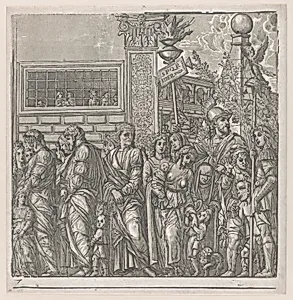
Sheet 7: Procession, from "The Triumph of Julius Caesar"
Medium
Chiaroscuro woodcut from four blocks in gray-green ink
Dimensions
Sheet: 15 7/8 × 15 3/8 in. (40.4 × 39 cm) Image: 14 7/16 × 14 9/16 in. (36.7 × 37 cm)
Classification
Prints
Department
Drawings and Prints
Museum
Metropolitan Museum of Art, New York, NY
Credit
Rogers Fund, 1922
Accession Number
22.73.3-95
Rights
Public Domain
Tags
Art Historical Context
Step into the grandeur of ancient Rome with *Sheet 7: Process, from "The Triumph of Julius Caesar*, a masterful 1599 chiaroscuro wood by Andrea Andreani after designs by the Renaissance genius Andrea Mantegna, with contributions from Bernardo Malpizzi This print is part of a celebrated series recreating Mantegna's canvases, painted around 1482–1505 for the Gonzaga court in Mantua. These works captured Julius Caesar's historic triumph—a lavish parade celebrating his Gallic victories—reviving classical antiquity during the Italian Renaissance, when artists eagerly emulated Roman grandeur to inspire patrons and viewers alike. Andreani's innovation shines in the medium: a chiaroscuro woodcut printed from four blocks using gray-green ink, which masterfully simulates the dramatic light and shadow of painting. This technique, rare and technically demanding, layers tones to create depth and volume, transforming flat wood into a three-dimensional spectacle. Measuring about 15 inches square, the sheet teems with life: soldiers in gleaming armor, boys and infants, men and women in flowing robes, all marching in rhythmic procession. Housed in the Metropolitan Museum of Art's Drawings and Prints department (Rogers Fund, 1922), this print not only preserves Mantegna's vision but highlights printmaking's role in democratizing elite art, making Caesar's glory accessible beyond palace walls. A testament to Renaissance ingenuity and humanist passion for history!