
Shelf Clock
c. 1938
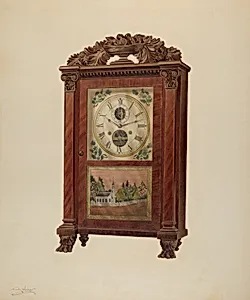
Medium
watercolor, colored pencil, and graphite on paperboard
Dimensions
overall: 54.8 x 45.5 cm (21 9/16 x 17 15/16 in.) Original IAD Object: 31"high; 8"wide
Classification
Index of American Design
Department
CG-W
Museum
National Gallery of Art, Washington, D.C.
Credit
Index of American Design
Accession Number
1943.8.4718
Rights
Public Domain
Art Historical Context
**Shelf Clock**, a meticulously rendered depiction by artist Frank Wenger around 1938, captures the elegant simplicity of an American shelf clock standing 31 inches high and 8 inches wide. Created as part of the Index of American Design (IAD), this watercolor, colored pencil, and graphite work on paperboard (54.8 x 45.5 cm) showcases Wenger's precise hand in documenting everyday objects that embody early American craftsmanship. Housed in the National Gallery of Art, it invites visitors to appreciate the clock's functional beauty—likely a product of 19th-century clockmakers blending practicality with subtle ornamentation. The IAD, a Works Progress Administration (WPA) initiative from 1935 to 1942, employed artists during the Great Depression to preserve America's folk art and design heritage through over 15,000 such renderings. Wenger's contribution highlights the cultural importance of household items like shelf clocks, which were staples in colonial and federal-era homes, symbolizing self-reliance and ingenuity in a young nation. Wenger's mixed-media technique—layering translucent watercolors for depth, colored pencils for fine details, and graphite for sharp outlines—ensures scientific accuracy while evoking the object's tactile warmth. This artwork not only safeguards vanishing artifacts but also celebrates American decorative arts, bridging history and artistry for today's museumgoers.
About the Artist
Frank Wenger · 1855–present
**Frank Wenger** (American, active c. 1935) was a meticulous artist whose precise renderings captured the elegance of traditional American furniture during the Great Depression era. Little is known about his early life or formal training, as biographical details remain scarce. What endures is his substantial body of work—over 50 pieces—created as part of the Index of American Design (IAD), a Feder...